Wednesday, July 6, 2011

Lammergeier: Gypaetus barbatus

Another vulture, a cousin of the Egyptian vulture, only this one eats bone instead of carrion. How awesome is that?


The Lammergeier is an old world vulture with feathers on its head. 1) it lives at high altitudes and has to stay warm, and 2) doesn't eat meat so sanitation isn't the issue that it might be for other vultures.

The Lammergeier looks for other vultures and then waits for them to finish before swooping in to take the bones. If they can't swallow them whole, they fly with them and drop them until they break. It can take a young Lammergeier years to learn exactly how to break the bones.

The vulture's digestive system is really acidic, allowing it to dissolve the bone and take advantage of the marrow.

Check this out:

Thursday, June 23, 2011

Lappet-faced Vulture: Torgos tracheliotos

If yesterday's vulture was the wizened elf of the vulture world, this guy is its fierce giant.

Lappet-faced vultures are large, roughly 4 feet tall, and they're a more aggressive vulture. Their size and (relative) ferocity means that most other birds scatter when they come to feed... not necessarily a bad thing because lappet-faced vultures have very strong beaks capable of tearing at carrion that other birds (or mammalian scavengers) might not be able to manage.


Lappet-faced vultures are old-world vultures (Asia/Africa), related to hawks and kites; their feet are strong enough that they could conceivably use them to kill, even though they're primarily carrion eaters.

By the way, according to Mirriam-Webster, a lappet is a fold or flap on a garment or headdress or a flat overlapping or hanging piece, and in this case it refers to the flaps of skin on either side of the lappet-face's head/neck... Attractive... NOT.

Doodled from this photo at Wikimedia Commons.

Wednesday, June 22, 2011

Egyptian Vulture: Neophron percnopterus

I'm way into vultures at the moment. They're ugly, sure, but they fill a unique ecological niche that's kinda cool... they eat dead things. They're carnivores who (usually) don't kill their meals.

The Egyptian Vulture is one of the smaller old world vultures, and frankly, one of the more attractive.


Smaller, more attractive, and fairly intelligent... it uses rocks to break into ostrich eggs.


Cool, right?

By the way, Egyptian Vulture's are also known as Pharaoh's chickens, they have their own hieroglyph and this one was doodled from a photo at Wikimedia Commons.

Monday, June 13, 2011

Ballpoint Pens are Evil... but Fun


My habit, of late, has been to find a wildlife photo and try to draw its subject... using a ballpoint pen. The other trick? I can't spend more than about 30 minutes on it.


There are people who are brilliant at drawing with pens. I'm not one of them. I like them because they don't smudge (well they do, a little, if you dampen them... see the crow from my last post). But they do nothing for my self-esteem.


On the other hand, they're really easy to critique because none of the lines go away. I got the owl's beak all wrong, for instance. And the swift's shading isn't all that. Easy to see once you step away for a minute.

Tuesday, June 7, 2011

More Doodles

Doodling with a pen is a different experience for me than doodling in something less permanent.


I tend to start with the eyes and then draw everything else in relationship to them, especially with birds. With horses, or kinkajous, not so much... not sure why. Or maybe I am.


Birds don't have expressive faces, but they do (or can) have expressive eyes. Windows to the soul? Maybe not (word has it that an owl's eyes are so large that there's just not that much space left over for the brain in the skull), but it sure makes them interesting.

Friday, May 6, 2011

BBC Wildlife

A couple of years ago I pulled BBC Wildlife magazine off the shelf at my local Barnes & Noble. I've been shelling out the $7.99 to buy them ever since... they're what I want National Geographic to be. That is, it's the perfect magazine to carry around with you if you like to practice drawing animals from photographs.


The magazine features animals I wouldn't see here, like this crane photographed in Sweden.

The articles are informative as well.


Did you know, for example, that the house sparrow (Passer domesticus) is in decline in the UK? Maybe they'd like some of mine, although it would mean slimmer pickings for the neighborhood hawks.

The best thing about it is that it's easy to pull a magazine out of your backpack at an airport Starbucks and have a go at whatever strikes your fancy. I also tried a harp seal pup and a portrait of a fox this month. Drawing from photographs doesn't usually yield terrific artistic results -- and because selling or exhibiting any drawing based on a photo from a magazine would be copyright infringement, it's not a great idea to invest too much time in trying to make a masterpiece. But doodling from photos is a good way to figure out the anatomy of the thing without having to work in split-second increments... because, you know, wild animals move around a lot.

Friday, April 29, 2011

Delinquent

Believe it or not, I'm drawing more than I ever have... and a lot more in pen... but most of it's crazy prep drawings that aren't really fit for human consumption.

Some of the nicer ones from recent days:


Dana came home with a popular men's magazine, and Matthew McConaughey was on the cover. Fine, great, whatever. BUT. The photo spread inside the magazine also featured a Cinereous Vulture. Awesome!

A random macaw:


A fern front surreptitiously plucked from the side of a tree:


The head of a Downy Woodpecker:


Dandelion bits, sketched "in the field" at the Union Bay Natural Area... actually, sitting at the side of a raised bed and plucking bits of dandelion plant to observe and draw. Not very exotic, granted, but I don't feel badly about dismantling dandelion plants, for one. And from a botanical drawing standpoint, they're good to observe because they tend to do everything (bud, flower, go to seed) all at once.


I'll try to be better going forward, but the next four or five weeks are going to be harrowing. One of my classmates said that she made a list of everything she has to do, and for the first time ever, it didn't make her feel better.

Hmmmm.....

Sunday, March 20, 2011

Bernini & the Camera

Birdie doesn't like cameras very much, despite the fact that she's a total ham.


She uses her crest the way we use our eyebrows. "What are you looking at?!"


(Notice her orange eyes - when she came to live with us 12 years ago (!), her eyes were black... we thought she was a he for that reason. She's been sexed using DNA, but her orange eyes were our first indicator that we might have misnamed her.)

Something you might have realized, but just in case not, here's something to think about: most birds look almost silly when viewed head on...


... Little Bird is no exception.

Saturday, March 12, 2011

Working It Out

OK, given that I am not a watercolorist, I am extremely happy with the way this painting is coming along, and here's why:

  1. There's actually some contrast between the background and the subject, and

  2. The bird hasn't gone flat or muddy.


Trust me, these are huge steps for me.

Still to do: flesh out the background a little bit more and push it back a bit by neutralizing the green.

Friday, March 11, 2011

Watercolor Doodles

I am many things in this world: daughter, sister, wife, decent cook, lover of birds, reading enthusiast...

What I am not, however, is a watercolorist.

I would like to be one, someday, but for now I'm in that experimentation stage where nothing is very good... and it took me a fair amount of time to get here. But I have decided that I like these little doodles. Not because they're great watercolors, but because they give my journal a shot of color and life, which, if you've read my journals (which tend to be composed primarily of lists and complaints), you'd know that they sorely need.

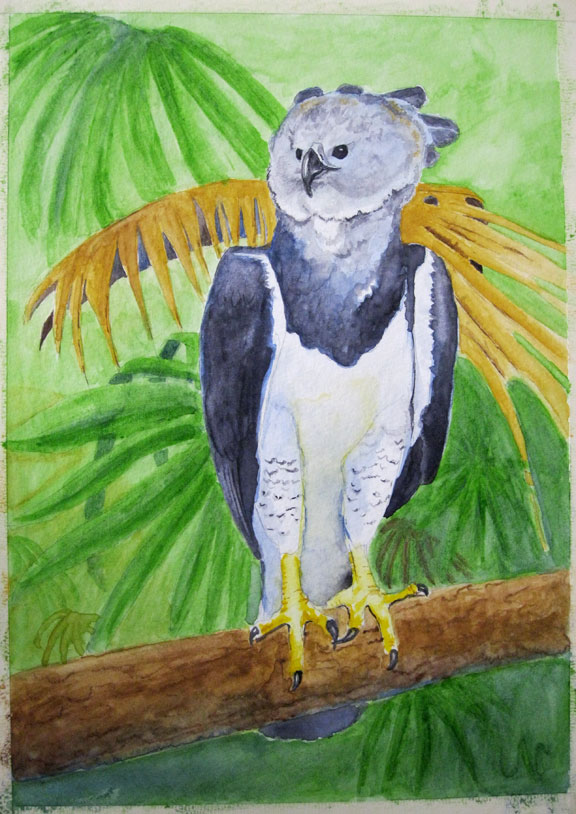
I'm working on an illustration of a Harpy Eagle for one of my classes. I read somewhere that Harpy Eagles have facial disks, like owls, as a result of convergent evolution. Unlike owls, though, Harpies create their disks by raising their feathers. When the feathers aren't raised, the Harpy has a noble profile.


Puget Sound is home to three pods of resident Orcas, numbering (in total) more than 80 of these very large ocean dolphins. The resident Orcas eat only fish and can be quite vocal, whereas transient Orcas eat all manner of sea mammals and are completely silent. (The things you can learn in class...) I made this little doodle while sitting in one of the Starbucks shops at SeaTac after my flight had been cancelled. The act of concentrating on my little painting was actually quite calming.


I found this image in one of the most amazing magazines ever, BBC Wildlife. A couple of months ago they did a feature story about Caracals.


I'm working on another set of illustrations for a different class, of the Columbia Basin Pygmy Rabbit. Extinct in the wild, this genetically distinct cousin of the Idaho Pygmy Rabbit lived in portions of Douglas County, Washington. The reasons for its genetic extinction are unknown, but it looks like it may have been a combination of factors including (but not necessarily limited to) habitat destruction and disease. The Idaho Pygmy Rabbit failed to gain federal endangered species protections last year, and because its range is - over time - being converted for agricultural use, it may eventually meet a similar fate.


Another magazine find, this time on a bumpy flight back to Spokane from Seattle. It was soothing to think about how I would approach this little doodle while we were being buffeted by crosswinds on approach.


All of these doodles are being done in my Moleskine sketchbook journal and I didn't spend more than 45 minutes to an hour on any of them... the paper isn't noted for being great watercolor paper, but for my purposes it works just fine.

Monday, February 28, 2011

Why did the Snow Goose cross the road?


To visit a thousand of its closest friends...

I went birding this weekend in Skagit County with seven other enthusiastic classmates. The enthusiasm was necessary because IT. WAS. COLD. And snowy and icy... but we still had a good time looking at Bald Eagles, Northern Harriers, a Rough-legged Hawk, a Merlin, a Peregrine Falcon, Pheasant, American Wigeons (plus one Eurasian Wigeon thrown in for fun), Killdeer, a Kestrel, Dunlin, Green-winged Teals, Blue Herons, Snow Geese, Trumpeter Swans, a Winter Wren and one Spotted Towhee (dead, retrieved from the road by yours truly).

Then, because I like having wind-burned cheeks (NOT), I got up on Sunday and went for a short loop around the Union Bay Natural Area, where the highlights were six Great Blue Herons and a couple of Golden-crowned Kinglets (who always make my day).

Yesterday evening and this morning I worked on a very preliminary value study of my next big project: a Harpy Eagle.

Saturday, January 29, 2011

Stellar's Sea Eagle

I was at the zoo today and saw the most amazing bird: the Stellar's Sea Eagle. You can't get a sense of the scale of this bird by the sketch, or the impressiveness of its beak (partly because it's foreshortened in this view), but it is amazing.


The Stellar's Sea Eagle is one of the largest eagles in the world by weight, but its measurements don't add up to the Harpy Eagle or the Philippine Eagle. Still, though, it's an impressive bird.

Doodled from this photo.

Thursday, January 27, 2011

Let's call the whole thing off!

I made it for 26 days before throwing in the towel - longer than an average New Year's diet, perhaps, but not very long in the grand scheme of things.

The problem? I'm bored. I think the project wasn't well-considered enough, because it's boring the snot out of me. I adore birds, and will continue to draw them here, but maybe a week is more than I want to spend on any one bird for now. That, and at the moment, I'm working on snapping turtle jaw anatomy, horse vertebrae, a rabbit skeleton and a nascent river otter illustration.

This is supposed to be the place for me to blow off steam, and any 365-day project in the future will have to take that into consideration. I still want to do one, just not this one.

Oh well. Lessons learned.

Wednesday, January 26, 2011

Atlantic Puffin: In Color

What?! There's no Atlantic Puffin here!

For now.

This has been the day from H - e - double-toothpick, so I'm putting a placeholder here at 10:45 p.m. so I can fall into bed and get some sleep.

Yes, I know, I'm cheating... but I did say I could change the rules any time I wanted, right?

Tuesday, January 25, 2011

Bonus Bird: Harpy Eagle

Dana was in Belize last week, and he got to feed a Harpy Eagle!


This is Panama. He's an education bird at The Belize Zoo.


Look at those talons. I learned last night that the longest talons on a bird of prey are the hallux and the inside front toe... because those are the ones they use to kill their food.

Note to self: stay away from Harpy Eagles in dark alleys.

Atlantic Puffin: Graphite

Monday, January 24, 2011

Sunday, January 23, 2011

Saturday, January 22, 2011

Atlantic Puffin: Research


Photo by Steve Garvie, via Wikimedia Commons

The Atlantic Puffin (Fratercula arctica) is a bird I've never seen in life. But I really, really want to see one. This is a bird I would be willing to travel to see, even though they live where it tends to get cold. It's not that they're rare, or that there's even anything that interesting about them... except that they're pretty, or at least distinguished looking. With their black and white plumage and colorful beak, they look like clowns that are slightly worried about something. Some folks might find that creepy, but I kind of like it.

Atlantic Puffins are seabirds, members of the auk family. They eat fish, primarily, and nest on rocky outcroppings next to the sea in the North Atlantic. It has some clever, if obvious, nicknames: "clown of the sea" and "sea parrot."

Puffins have fairly long lives, and can live up to 30 years. They live primarily at sea, but when it comes time to nest, they live in colonies and nest in burrows on cliff sides. Dad clears the burrow; both mom and dad incubate the eggs and care for the chicks until they fledge.

Friday, January 21, 2011